London Design Biennale 2025 review for Building Design.
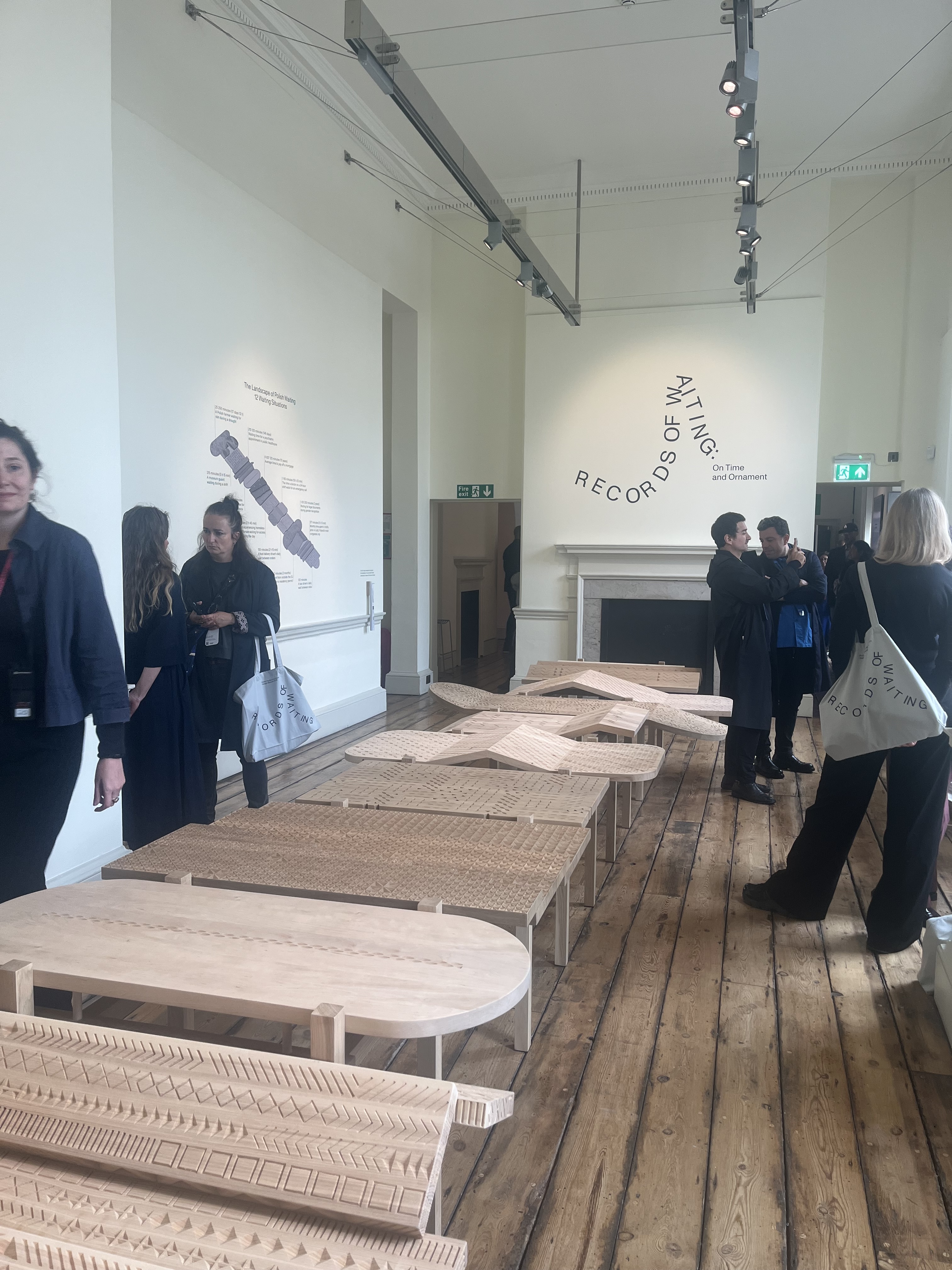
“Poland’s Records of Waiting uses the patient act of woodcarving to make the experience of waiting tangible. As in Venice, a team of Polish curators has delivered social commentary with wit and conceptual and graphic clarity (and win a medal for the most inspiring interpretation of the Biennale’s theme).”
It’s raining and I’m late to Aldwych for the start of the 5th London Design Biennale. No canals, no sun, no tiny little sandwiches. London feels like Venice, decaffeinated. I expect to be greeted by some great Thing in the Somerset House courtyard, but it’s empty of branded archways or Instagram bait. Just wet cobbles and the ordered neoclassical panorama that conceals the infernal maze behind its walls.
It turns out to be a sign that this year, spectacle gives way to something more reflective, in tone and theme. ‘Surface Reflections’, conceived by Artistic Director, Dr Samuel Ross MBE, investigates our personal histories; the experiences and influences that fuel design ideas.
Late to the press conference, I miss the speeches but find myself alone in the hall with Victoria Broackes, the Biennale’s Director. With the poise of a dishevelled Columbo, I ask how, with Venice’s 19th architecture launch still fresh, London’s compares.
London “models itself on Venice” for international collaboration. She tells me there are 35 main exhibits, but many more cross-national collaborations, including 30 countries under Azerbaijan’s banner and 7 via the World Monuments Fund. “We’re spanning six continents,” she says, but the real purpose goes beyond geographical spread to interrogate the nature of design in 2025: “What can it do?”
She points to a new research and innovation strand, and a collaboration between Northumbria University and UCL to investigate growing building materials. “These are experimental materials,” Broackes says, “we’re not sure what is going to happen.
Biofabrication was also the subject of Canada’s pavilion in Venice: an incubator testing the ability of unsettling 3D-printed Aliens to sequester carbon. In London, it’s a more conventionally useful laboratory, showing different material growths aided by microbes and fungi. I walk in at the exact moment a researcher tells a visitor, “The smell? It could be this polymer. Here’s the E. coli…” and quickly backtrack. It’s enough for me to know that building matter could be grown…
Read the full piece: https://www.bdonline.co.uk/briefing/surface-reflections-a-quieter-more-thoughtful-london-design-biennale/5136407.article




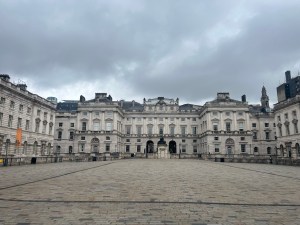
London Design Biennale ran from 5th-29th June at Somerset House: https://londondesignbiennale.com
 Editorial Content