Just before the pandemic, I interviewed one of my old tutors, Dave Smith. We had a long conversation about the thinking behind the Interactive Arts degree, a ‘radical art education’. I had the vague plan of writing something on the course when I heard it was ending, but then came home-schooling, work, unfinished projects… Dave died in April this year. He was passionate about education and creativity; his influence on many of our lives is probably greater than he ever realised, as all the wonderful tributes to him since have shown. This is my unfinished text on Interactive Arts, based on that conversation. Because by the government’s reckoning now, there’s no real value in ideas.
Interactive Arts

Interactive Arts was an experimental degree course, which ran from 1993 to 2020 at Manchester Metropolitan University. Its premise was the idea of creativity as the “seminally enabling, transferable skill for an unknown technological future” – now we’re in that future, it’s clear it was ahead of its time.
It was set up by lecturers, Tony Eve and Dave Smith, who taught together on MMU’s Art Foundation course. For Dave, Interactive Arts represented the pair’s life’s work in education, the culmination of more than 60 combined years of research. He told me they thought it could be “as influential as the Bauhaus.” But where the Bauhaus was craft-based, he and Tony saw craft only as a vehicle for an idea. Their curriculum, such as it was, was broad and outward-looking. There was a focus on independent studio work, and a programme of lectures that extended beyond art to include psychology, film, business and literature; they invited whoever they knew and persuade, or seemed interesting at the time.
There were some consistent themes. Dave produced a lecture series on ideation and creative thought, drawing on Buckminster Fuller, Edward de Bono and the Universal Traveller to try and help students investigate their perceptual blocks and become great problem-solvers. After he retired, this programme was taken over by Hazel Jones, an artist and senior lecturer, who worked on the course from these early days until its closure. The course leaders also struck an unusual deal with the faculty. They would open IA’s lectures to the rest of the art college, on condition that its students could go to lectures on any other programme. It might have been a little disappointing for Dave that few ultimately did, at least in my time. But for those exceptions, it was a great opportunity. And besides, the tutors weren’t a model of inter-departmental collaboration. Instead of mixing in the faculty staff room, they hid in a cupboard they had made their office.
A formative education
The founders had a vision for a course that would break down the traditional art school hierarchy, with its distinction between ‘tutor’ and ‘taught.’ They saw grading students as detrimental to the spirit of open collaboration they wanted to foster, so campaigned for a more equitable ‘pass or fail’ (an idea thwarted by the university’s administration). Ideologically, this was important to Dave. He recalled how in the late ‘60s and early ‘70s, he taught part-time on an architecture course in Liverpool. He hated the crits and assessing the undergraduates; he called the process, “a device to maintain the balance of power and serve the university, but not the students.” To counter it, he tested an alternative way of evaluating their work. He assigned three bodies the task: the faculty (as he was obliged to do), the students and the dinner ladies. The last group was the most generous in their encouragement, while the tutors were the toughest critics. This experiment was a model for the peer-review system adopted for Interactive Arts.
Dave talked about his own education, which was formative in different ways. He didn’t do well at Sale Grammar School, he said, tending to find himself “fantasising about the violent overthrow of the teachers – a bit like in If, the ‘60s film”, but he found a way out through the North West’s textile industry. His father worked for S. J. Watts & Co., a wholesale fabric business, and he coached Dave for an interview with Calico Printers’ Association. He got the job, and from there made it to design school. This environment transformed his worldview; he was inspired by African batiks and the new intellectuals around him, “some of whom even liked opera” he said.
In 1959, he did an Art Foundation course. It wasn’t long before he got into teaching and found it was something he enjoyed and was good at. But at every stage, he found himself questioning the system, and what he felt was an unnecessary level of compliance – and his role in it. He described art education in the UK as “behavioural conditioning, set up to control people.” He saw Interactive Arts as an opportunity to redress the balance, and taught on the course from its inception until he took early retirement in 2001. His departure was partly down to the way he saw their vision going – as a socialist, he completely rejected the introduction of tuition fees. He felt that students would see themselves as customers, without agency, in an experiment that had set out to challenge that balance of power.
Dave was dogmatic that Interactive Arts wasn’t about churning out artists. Manchester already had a Fine Art degree – they occupied the other side of the main studio, over a chipboard partition that was rarely crossed. But over time, as the course evolved from the aims of its founders into the care of a faculty of practising artists, under very different political circumstances, it was hard to resist a pull in this direction. But graduates have used the Interactive Arts experience as a springboard into many other fields, from a housing development company to Hollywood effects. Our cohort alone included celebrity makeup artist, Andrew Gallimore and BAFTA-winning film director, Colin O’Toole.
Creative Futures
One enduring sticking point, which hints at tensions contained in the boxes of administrative papers Dave held onto in his Marsden home, was the course’s name. Its founders wanted to call it Creative Futures, but the university wanted to have a clearer subject in the title, to give it the authority of a conventional degree. So, it became Interactive Arts, implying networks, and the exchange of ideas between disciplines and communities. However, with ‘interactive’ soon synonymous with digital, I wondered if MMU’s £35-million School of Digital Arts (SODA), a centre for art, design and technology that opened in 2021, was a catalyst for its obsolescence.
It reminds me of a quote by Norman Foster, another great Mancunian. Despite a reputation for technically advanced architecture, he always liked to make the point that “in terms of creativity, the computer, like the pencil, is only another tool (albeit a formidable one) and is only as good as the person driving it.” So, as the next generation of students explores the applications of technology in a building wrapped in a big screen, are they as free to develop their analogue creativity? In a big, expensive home for digital making, is it as easy to find the wider perspective to see technology as a tool? Interactive Arts gave us that breathing space for thought, tea and ideas; there has never been a better time for Dave’s lectures on ideation than now.
Class of 2000: the student experience
My memories of Interactive Arts are broadly positive, but I wouldn’t say the experience was without challenges. I was a student in the late ‘90s, the graduating class of the millennium. I shared an area of the studio with Nicola Dale who, among other epic works, alphabetised Kafka’s Metamorphosis, Gemma Holt, who invented a new paper size (used today in books by publisher, Dent de Leone), and Helen Eastwood, who knitted cosies for early mobile phones. We were surrounded by painters, animators, photographers, sound engineers, film directors, performers, and the absentees that occasionally appeared to sign the attendance sheet.
We felt like participants in a social experiment. In the first week, looking around at the other students sitting in a circle, there were all ages, nationalities, and backgrounds; a charismatic hairdresser from Barcelona, an accomplished cellist, and two students with pet rats up their sleeves. It was completely open-ended; you could pursue any idea or format you could justify. As a result, the output was unlike anything produced by a more disciplined Fine Art programme.
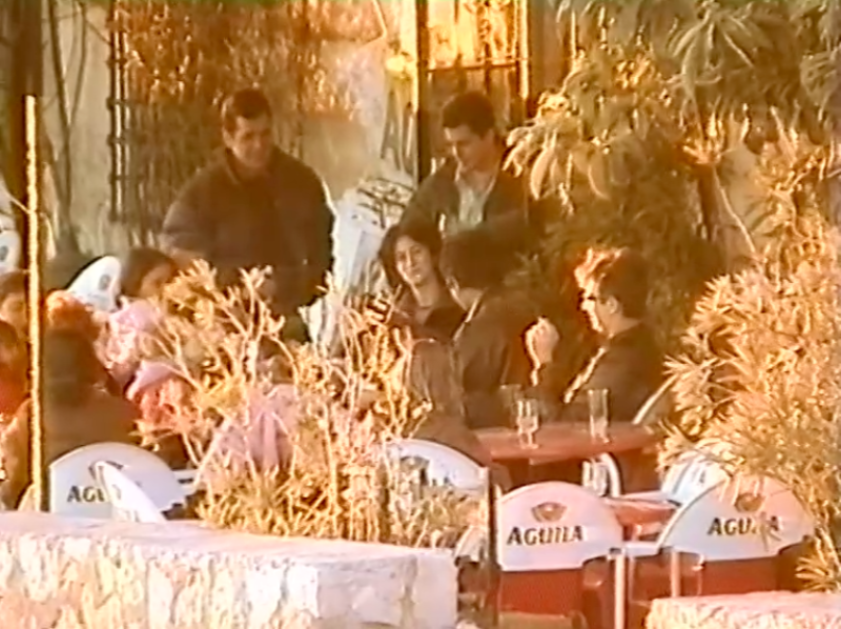
The hours were full-time, though I spent a few of mine in the building’s chrome and Formica café, drinking tea with my friend. Everyone around me seemed to have such certainty about their interests and the work they wanted to pursue. My ideas weren’t necessarily bad, but I was always trying to rush them to a resolution, so found it hard to trust or enjoy the process. The turning point was a change of scene and an Erasmus placement in Spain. By the end of the final year, I had a small tattoo, a giant photograph of a pantomime horse pushing an industrial buffer, reams of explanatory texts (that would go on to define much of my career) and a degree of reasonable merit. But the valuable legacy of the course, for me at least, is more an attitude, an enduring state of mind – a willingness to question perceived wisdom, not always with the best outcomes, but with the confidence to always try something different.
The end
I was disappointed to hear Interactive Arts was coming to an end, and travelled up from London with Gemma Holt for its send-off at the start of 2020. We were nostalgic for the course as we knew it, and sad for the loss of all the knowledge and experiences accumulated over its twenty-six years. But does it really matter to more than its final cohort of staff and students? I suppose that question contains the essence of what it set out to achieve. When I came to write about Interactive Arts, I was hesitant, and this text still isn’t finished for a reason. It needs more perspectives. Its story should be told by the course’s founders, or its more celebrated alumni, I thought. Dave might disagree – as he said, it was all about the collective.
The conditions no longer exist for an experiment like Interactive Arts – financially, academically, or otherwise. It was of its time and can’t be replicated. That isn’t to say there aren’t radical new forms of art education: the School of the Damned, for instance, an entirely peer-organised postgrad, or IA alumnus, Ryan Gander’s Fairfield International. But as we move into the age of AI, with the tools at our disposal to outsource our imaginations, there has never been a greater need to understand the value of ideas, and to develop the creative acuity to still have them.
Thanks Dave x
 Editorial Content