Review: Sean Scully at Houghton Hall
Every summer for the last few years, Houghton Hall in Norfolk has held an exhibition by a prominent artist; a commission for new sculpture in the grounds, and work on show in the house and two gallery spaces. This year, it’s the turn of abstract painter and sculptor, Sean Scully. Before visiting, I read a few comments on his recent works. “Exquisite. You break my heart,” said Guy. “This does my heart good,” wrote another. Indigo added that she “Felt this. Very deeply.” I couldn’t feel it, so wondered if the problem could be me; a depth I’m missing, rather than the painting.
Expectations for the show were further compressed by the gravity of Scully’s reputation as one of the most important painters of his generation. He was born in Dublin in 1945, grew up in England and lives between New York and Bavaria. He makes art “commanded by the idea of humanity’s betterment” – gallery fluffing that will set anyone up to fall short. And the tickets were £20 each. So I didn’t expect him to win me over so easily in the first room.
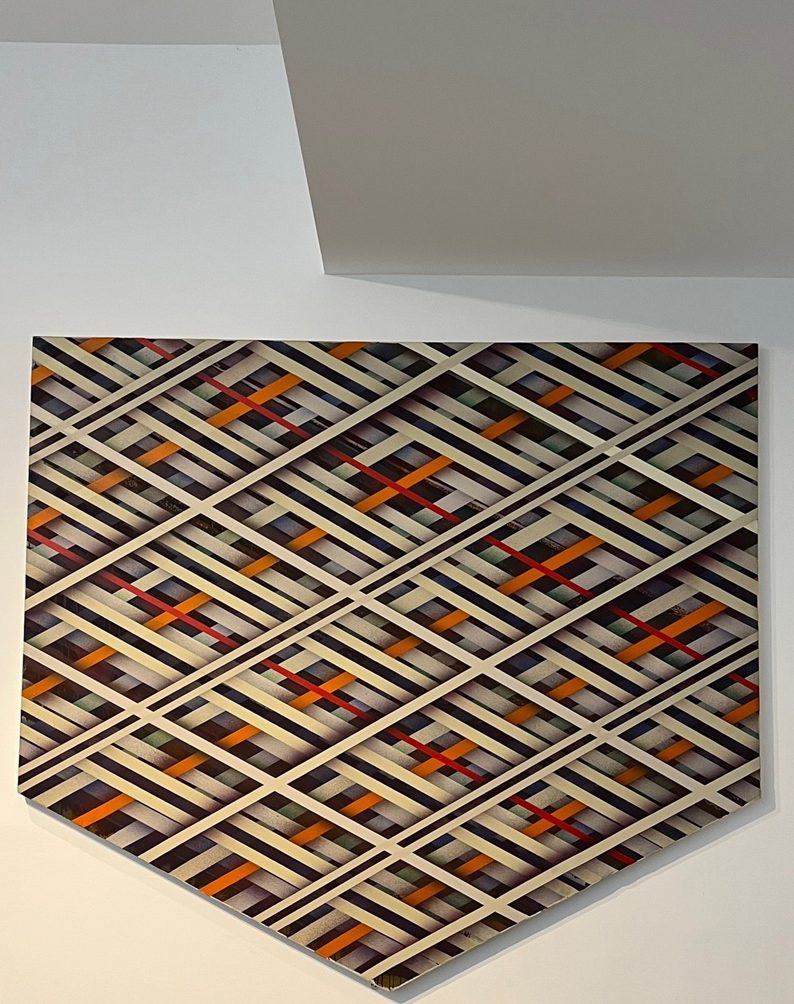
The focus of the South Wing Gallery is East Coast Light 2, 1973; a grid of layers and diagonals. The paint defines the shape of the canvas – it extends to a satisfying point to allow the lines’ natural conclusion. Facing the painting, it was the handwritten pages in glass cabinets that did it for me. In one, Scully remembers a job he had stacking and baling cardboard boxes at a Woolworth’s branch; he writes about the boxes’ ‘defeat’ and the drama of their compression, setting in context his future career: “I was already making tough art and I was only 15. It made me strangely curious about my possible future, which, I knew, back then, would not be normal.” These autobiographical notes, written with clarity and interspersed with watercolour sketches, give the exhibition an easy intimacy. In the corner of one page, a date and ‘Sydenham.’ I had him down as an Irish-American artist, inspired by distant and unfamiliar landscapes, but wait now, what, he worked down the road?
A shared place or memory can be a way in. Not necessary, of course, but helpful in finding a connection. Years ago, I had to write an essay on photographer, Eve Arnold; the first woman to join Magnum, the documenter of civil rights movements, 1950s Harlem and the faces of a generation, from Marylin Monroe to the Queen. A career it was hard to comprehend, at that time, from a small Midlands village. That is, until I discovered she took photographs at Kelham Hall in Nottinghamshire, about half an hour away. I went to have a look at the place, to find the grass she caught Father Gregory mowing in 1971. Pointlessly, I looked at a tree and wondered if it was the same one. But it unlocked a different way of seeing Arnold’s work, just as reading about Scully’s time in Sydenham, then his study at Croydon College of Art, helped to shift my perspective. The details in his writing opened up the paintings, which opened up the sculpture, and lifted some of the weight of his reputation.
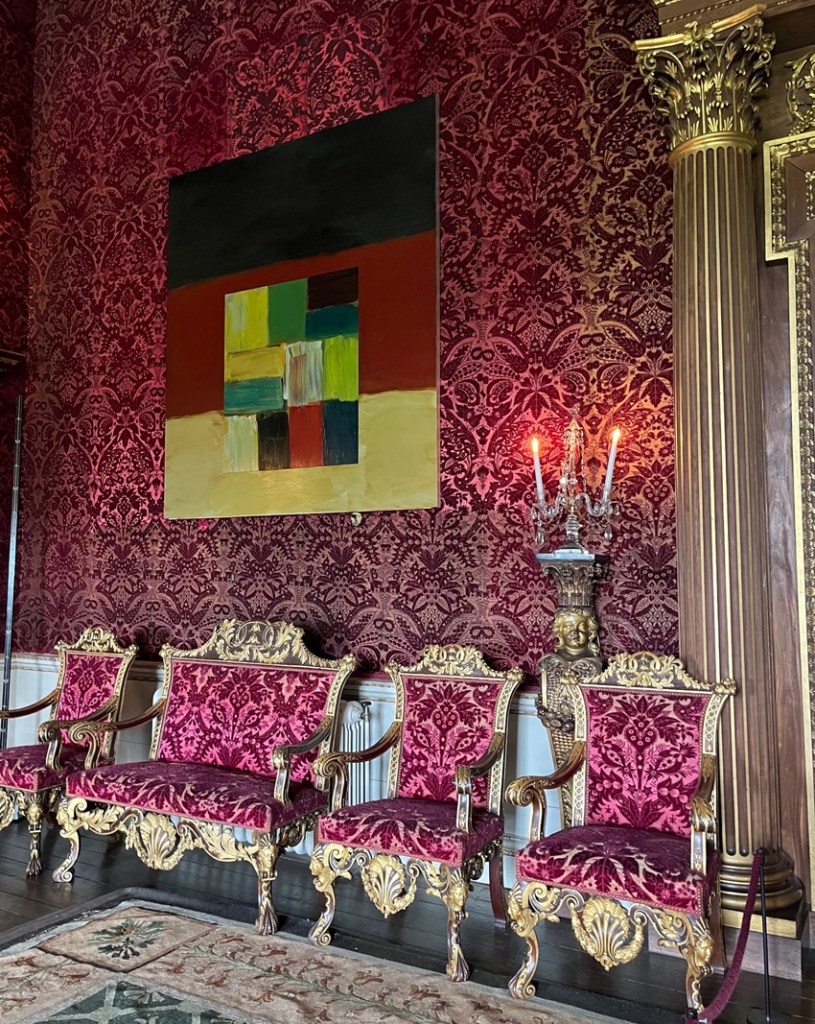
Houghton Hall itself is a grand Palladian house commissioned in 1722 for the first Prime Minister, Sir Robert Walpole. Today, it’s the home of the 7th Marquess of Cholmondeley and his family, who began the tradition of buying large scale contemporary art through the acquisition of a Skyspace by James Turrell. Scully’s work is displayed in the hall’s grand state rooms, and there’s a tension between the pieces and the ornate interiors – they don’t always seem comfortable guests. Two paintings, Wall Landline High Atlas 2022 and Wall Landline Uranus 2022, hung against the flocked crimson wall coverings, look like a Rothko-worthy provocation.
In the next room, a stack of stone stripes stands on a table in front of a heavily gilded mirror. The small sculpture is similarly wilful for its simplicity, its only decoration the natural colours and texture of stone. Further along, in William Kent’s wildly ornate Stone Hall, is a candy-like tower of coloured glass blocks, Glass Stack, 2020. It seems to be teasing the carved goddesses on the pediment, and the gold chandelier: “bit much, eh?”
Also on display here are pages of a book, Endangered Sky, a collaboration between Scully and poet, Kelly Grovier. The subject is the disappearing bird population, which feels particularly moving so close to Norfolk’s marshes. Scully made the images on an iPhone and each is paired with an elegy by Grovier for a lost or declining species.

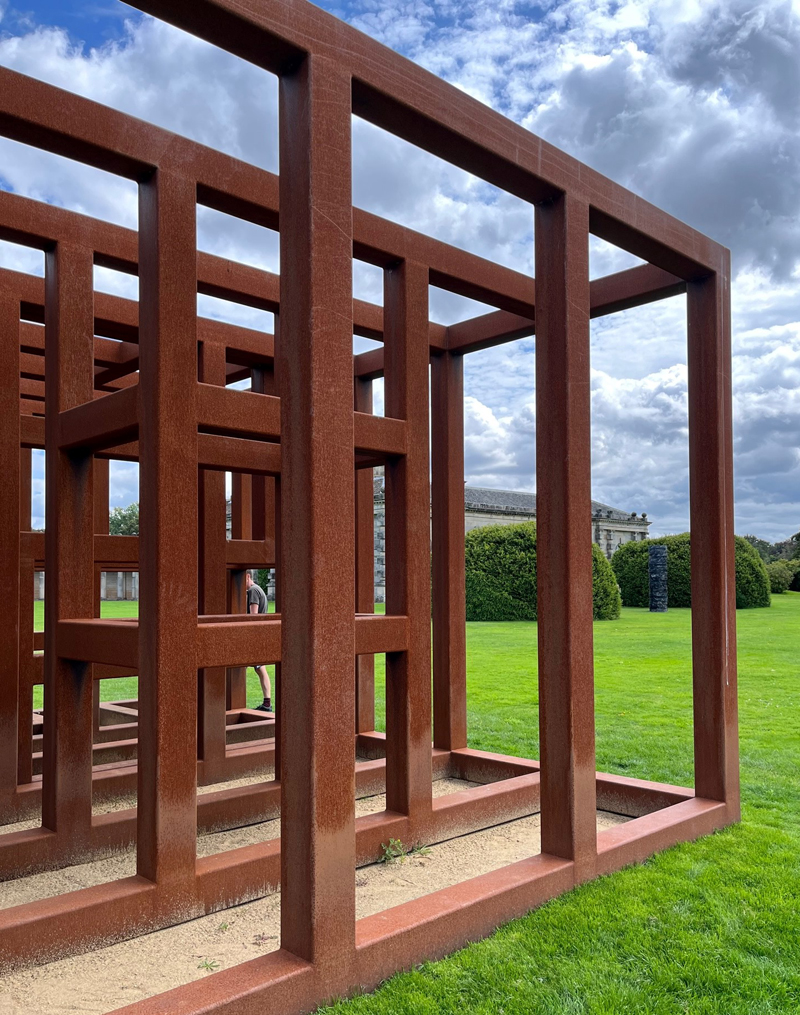
Outside, the sculptures take on a monumental scale. The largest, Crate of Air is a grid of Corten steel on the lawn in front of the house. I peer at details of the architecture through its frame, and the row of pleached trees at the edges of the lawn. It reminds me of a negative space study, an exercise in drawing a stack of chairs without the chairs.
As Houghton’s summer exhibition becomes more established, it’s interesting to see how artists respond to the same lawn. This is almost the spot where Anish Kapoor’s mirror reflected wide Norfolk skies in 2020, or Damien Hirst’s unicorn and winged horse duo, Myth and Legend grazed in 2018. By comparison, Scully’s work is tough, subtle and more open to interpretation. I want to see the patterns on the grass when it has left.
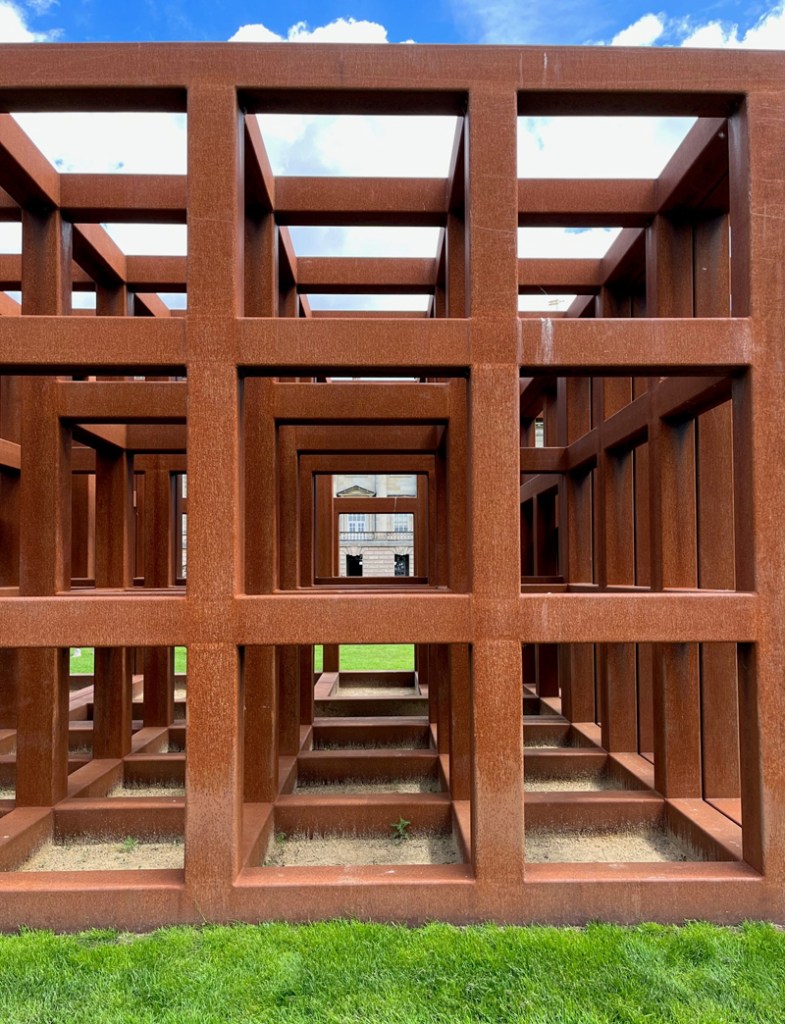
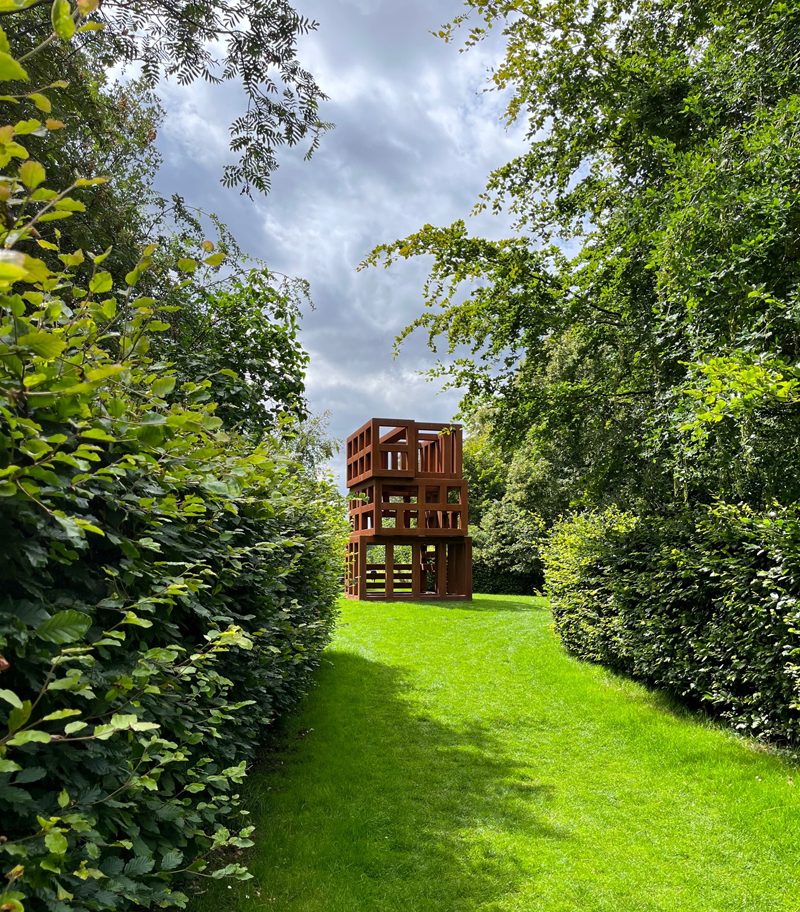
The rooms of the sculpture park are defined by hedges. Hidden behind are works by James Turrell, Rachel Whiteread, Richard Long and many more big names. In this maze, Scully has another, taller steel abstract grid in a clearing Air Cage, 2020, along with two works of compression: Round Sleeper Stack, a stack of deep bands of timber that appear to be splitting apart under their own force, and a square tower of industrial planks of wood, which might be thin railway sleepers.
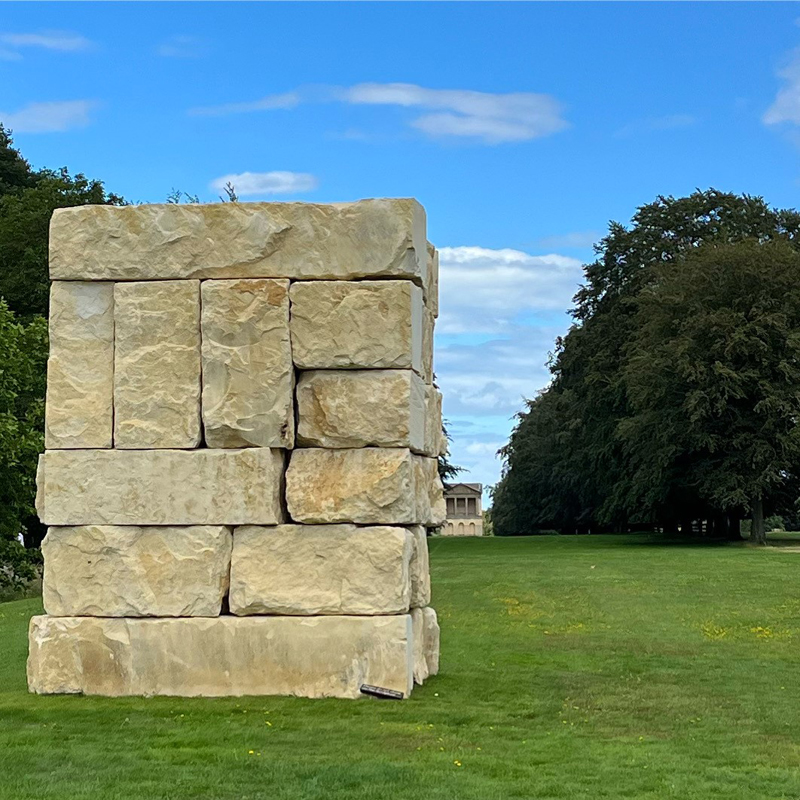
On another lawn, between the ha-ha and 18th century water tower, of course, is Tower Light Cubed, a sandstone stack. It feels lowbrow disrespectful to liken the stones to chunky chips. They change with the light, melt, and from different angles, rearrange themselves into what look like three-dimensional studies for Scully’s paintings. In its own rugged way, it seems grander than the water tower, with its portico and simple symmetry. But I guide my son away, because it also feels precarious on the damp grass.
The point of coming to Norfolk was a break from work, to live a little less in my head and more in the sea. Scully seems fitting for that. “Emotion will always conquer the idea,” he said in an interview. Leaving Houghton, I wanted to read more of his writing and spend longer with his paintings close-up. I wonder if I lived with one and looked at it often, it might offer consolation that I’m not missing anything at all.
Sean Scully, Smaller Than The Sky runs at Houghton Hall, Norfolk until 29th October.
 Editorial Content
Leave a Reply