
Last year, I submitted a piece of parquet from a former mission hall engraved ‘BENEATH THE PARQUET, THE DANCE FLOOR‘ to the Royal Academy’s Summer Exhibition. A reference to the 1968 Situationist ‘Sous les Pavés, la Plage!’ (Under the cobbles, the beach!). My hope was that the selection committee might see fit to pull up a block of gallery floor and swap it for my work. They didn’t. Nevertheless, I carried it to an event and took a photo of it in situ. It’s on my shelf now, I’m not sure I’d ever want to sell it.

This year, I’d been thinking again about Burlington House and something that had always bothered me about the Central Hall, which is that it isn’t an octagon. It’s a square room with walls added to each corner. It puts on the airs and graces of a more fanciful shape, but in that vanity, it loses surface area, because behind the corners are four quite substantial voids.
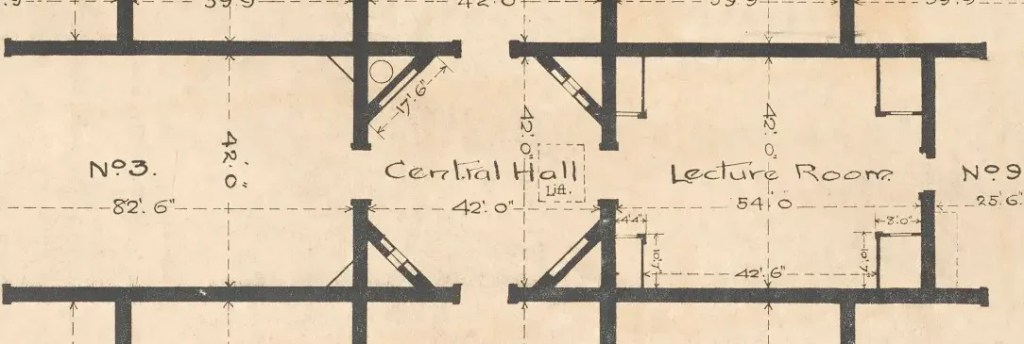
I researched drawings of the house and studied the more recent Chipperfield masterplan, but the voids remained a mystery. It looks like one might be part of a ventilation or heating system, one contains some kind of round structure, but the others are empty. Creepy to think of them hollow, full of dust or lost Academicians. Historic buildings specialist, Chris Dyson explained the poché, the French term for the negative spaces behind walls, which I read were sometimes used for niches or secondary rooms. In the context of the Wohl Hall, this ‘free’ space could let more artists into the show. The work became about their absence and then finding a means to connect them with the voids.
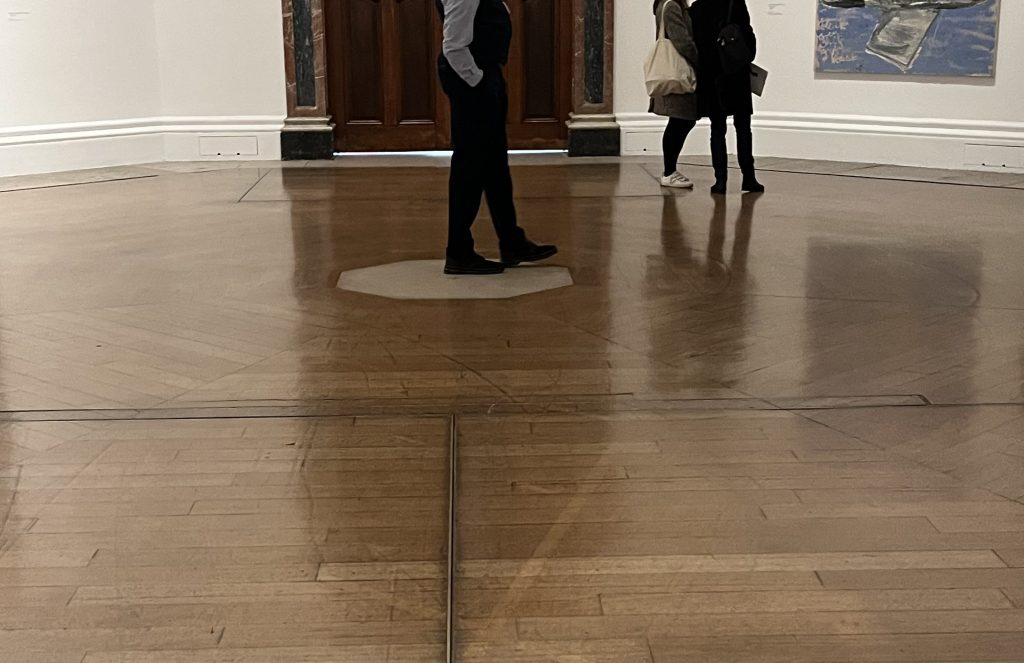
The initial plan was an entire secondary exhibition in the void, with mirrors to infinitely extend the space and audio, with the muffled sobs and chatter of the unselected and forgotten. But if the committee isn’t going to pull up one block of floor, they’re not going to take apart a wall are they, so I thought I’d claim the spaces on paper to describe a fictive show.
Errata, Void Exhibits (Burlington House, Central Hall), 2026
Errata is a loose leaf erratum slip to be added to the list of works to note the omissions in the four voids. To follow the format of previous catalogues, I bought a previous copy on eBay, but when it arrived, it only had 4/5th of its cover. “As you suspected, I cut through the cover when trimming the cardboard packaging to size” apologised the seller. “I suppose the cover was sticking up and I didn’t notice. I found this [section of cover] on the desk when I got home.” The catalogue of disasters he sent somehow added to the erroneousness of the work.

“Thursday was an all round bad day. Not enough sleep, rushing to get some chores done (including packing this little booklet) before going to the airport, then the real catastrophe of getting to Stansted airport only to find that my flight was from Luton and not enough time to get from one to the other. Total cost £250 to get another flight and train and taxi and missing one of the three days of the athletics competition that I went to watch. Still the other two days of athletics were very good with Sunday being exceptional. So all OK really. Hope you find another one. Sorry once again.”

When Errata was shortlisted, I printed the 100 sheets, numbered and signed the reverse of each one. The RA asks for work to be framed, but I wanted this to be stuck up loose with pins or tape. I did the closest I could by sawing a scrappy piece of ‘back wall’ in chipboard to match the dimensions of a frame and pinned the slip to it. When I dropped it off, the box contained the stack of 99 papers and a ‘framed’ slip with a note on the front to let them know the wall-mounted piece was optional.
The Royal Academician coordinating the exhibition this year is Ryan Gander, an artist I was confident would make some kind of mischief with the 250-year-old format. The show is full of ideas and unexpected details, such as his white gloss hanging/no hanging line that runs through all the galleries, a pastel cloudform by Fiona Clasen floating up high on the wall, a Gormley in the corner, a dog over a door and other works in unlikely places.

I didn’t expect Errata to be on the wall and on Varnishing Day, even told people that asked it was in the voids. It was a surprise to see it hanging in the Wohl Hall, a room curated by Ryan, perfectly sited as a discreet note by the exit; one for the rejected, the unsubmitted, the indifferent and the abandoned. It’s for sale for 10x the entry fee and the slips in the booklets are free to whoever finds them.

The Summer Exhibition is an annual prompt to share something. In other work, aside from writing, I’ve been making some new drawings and revisiting a mail art project I started 30 years ago. I still couldn’t decide whether it was a dead end, then by coincidence, saw a page that related to it in an issue of Real Review. I don’t know Jack Self, but thought I’d email him and see what he suggested. He replied with some kind advice, which I’m slowly working on; turning it into an artist’s book and planning a low-key event. (I’m being deliberately vague as other work keeps getting in the way and I’m not much closer to finishing it.) But, the thing that stuck with me and is relevant here is a point he made about his great grandfather playing the fiddle. And the very few things that people remember of us.
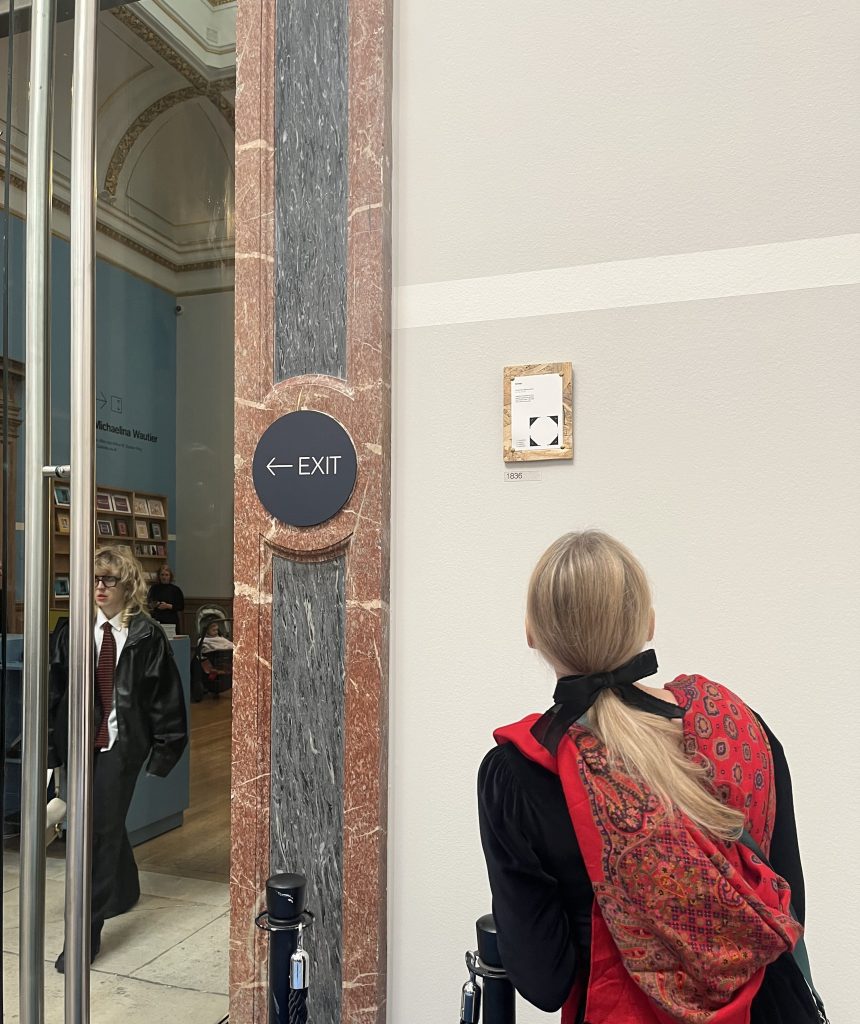
Because even if someone holds my work up as everything wrong, they hate conceptual stuff and won’t someone just think of the painters, you just have to keep doing it and having ideas don’t you. I trusted Ryan would do something interesting with the exhibition and it’s great, very lucky to be included. And my parents are proud I have something in the Royal Academy. In fact, lots of people have been really nice in congratulating me. Then I think, wait until you see it. You might be surprised that the sophisticated octagon is, in fact, a simple square with extensions.
Sarah Simpkin

